
Key Takeaways
- A foundation crack repair and waterproofing specialist that has served the Vancouver Lower Mainland for decades has expanded coverage to Victoria homeowners, strata councils, and commercial properties.
- Victoria’s rainy climate, dense clay soils, and older unreinforced foundations combine to make moisture management and crack monitoring especially important on the South Island.
- Wondering whether that hairline crack in the basement wall is harmless or a warning sign? The difference often comes down to direction, width, and whether water is getting through.
- Foundation crack repair costs vary with severity: interior crack injections often run in the low hundreds of dollars, while major structural work involving excavation or extensive carbon fiber reinforcement can reach into the tens of thousands.
- Carbon fiber reinforcement, ten times stronger than steel, provides a minimally invasive way to stabilize bowing basement walls without full excavation.
A cracked foundation rarely announces itself all at once. It shows up as a thin line on a basement wall, a damp patch after a heavy rainstorm, or a door that suddenly sticks in its frame. For homeowners and property managers across Victoria, BC, these small signs are becoming harder to ignore as older housing stock ages and wet winters keep testing every seam in a concrete wall.
Victoria Now Gets Vancouver Foundation Expertise
A concrete repair company that has spent decades working on foundations across the Vancouver Lower Mainland and Fraser Valley has expanded to Victoria, bringing crack injection, waterproofing, and structural reinforcement services to Vancouver Island. CrackMaster Concrete Victoria now serves homeowners, builders, strata councils, and commercial property owners on the South Island, applying techniques refined since 1994 in some of British Columbia’s wettest, most soil-sensitive terrain.
The expansion matters because Victoria’s foundation challenges differ somewhat from those on the mainland, even though the underlying concrete science stays the same. Older character homes near the downtown core, newer strata developments in Langford and Saanich, and commercial buildings with underground parkades all face slightly different pressures, but they share one thing in common: water finds the weakest point in concrete and eventually gets through it. Spotting that weak point early, and matching it to the right repair, separates a quick, affordable fix from a costly structural project down the road.
Why Victoria Homes Crack and Leak
Concrete handles being squeezed extremely well, but it struggles when pulled or stretched. That weakness in tension is why foundations crack in the first place, whether the cause is curing shrinkage, seasonal settlement, or steady pressure from soggy ground pressing against a wall. Victoria’s specific mix of climate, soil, and building age brings several of these stress factors together at once.
Older Unreinforced Foundations at Risk
Many homes in Victoria’s older neighbourhoods were built with stone or unreinforced foundations, long before modern reinforced concrete construction became standard practice. These foundations were never designed to flex or resist tension the way a steel-reinforced wall can, which makes them more prone to vertical cracking, shrinkage cracking, and gradual settlement. A foundation that has stood for eighty or a hundred years is not necessarily failing, but it may deserve closer attention than a more recently built home.
Rain, Clay Soil, and Seismic Pressure
Victoria’s mild temperatures mean freeze-thaw cycling is less of a concern than it is in colder parts of Canada, but the South Island trades that problem for another one: near-constant moisture. Heavy seasonal rain saturates the dense clay soils common across the region, and saturated clay swells and pushes against basement walls with real force. Add in the Island’s known seismic activity, and foundations absorb pressure from multiple directions at once, which is why cracks that might sit quietly for years in a drier climate tend to widen faster here.
Poor Drainage and Failing Weeping Tile
Water pressure against a foundation wall rarely comes from rain alone. It usually gets a boost from drainage problems that have been building for years, sometimes unnoticed. Common culprits include:
- Clogged gutters that overflow directly beside the foundation instead of carrying water away
- Downspouts that dump water only a foot or two from the house
- Weeping tile systems that have cracked, shifted, or clogged with silt and roots over time
- Grading around the home that slopes toward the foundation instead of away from it
Fixing a crack without addressing the drainage feeding it works like bailing water out of a boat without patching the hole. The repair might hold for a while, but the underlying pressure keeps building until it finds a new way through.
Reading the Warning Signs in a Crack
Not every crack deserves a phone call to a repair specialist, but knowing which ones do can save a homeowner from either needless worry or a costly surprise. The direction, width, and behaviour of a crack over time all tell part of the story.
Hairline Versus Structural Cracks
Hairline vertical cracks are extremely common and often just a normal part of concrete curing or minor settlement. As long as they stay narrow, do not grow, and are not letting water through, they usually are not cause for alarm. Structural concern rises with cracks that are horizontal, that follow a stair-step pattern through brick or block, or that continue to widen season after season. Any crack that leaks during heavy rain or snowmelt sends a clear signal that professional injection sealing or reinforcement is worth investigating sooner rather than later.
When Bowing Walls Signal Trouble
A wall that bulges, leans, or bows inward describes a different problem than a simple crack. Bowing usually points to sustained pressure from saturated soil pushing against the foundation from the outside, and it is often accompanied by horizontal cracking near the middle of the wall. This is the point where a homeowner should stop monitoring and start calling for an inspection, since bowing walls tend to worsen gradually and can eventually threaten the structural integrity of the foundation if left unaddressed.
Matching the Repair to the Problem
Once the type of crack and its cause are understood, the right repair method usually becomes fairly clear. Foundation repair is rarely one-size-fits-all, and a good contractor will match the approach to the specific wall, access point, and water ingress pattern rather than defaulting to the same fix every time.
Inside and Outside Crack Injection
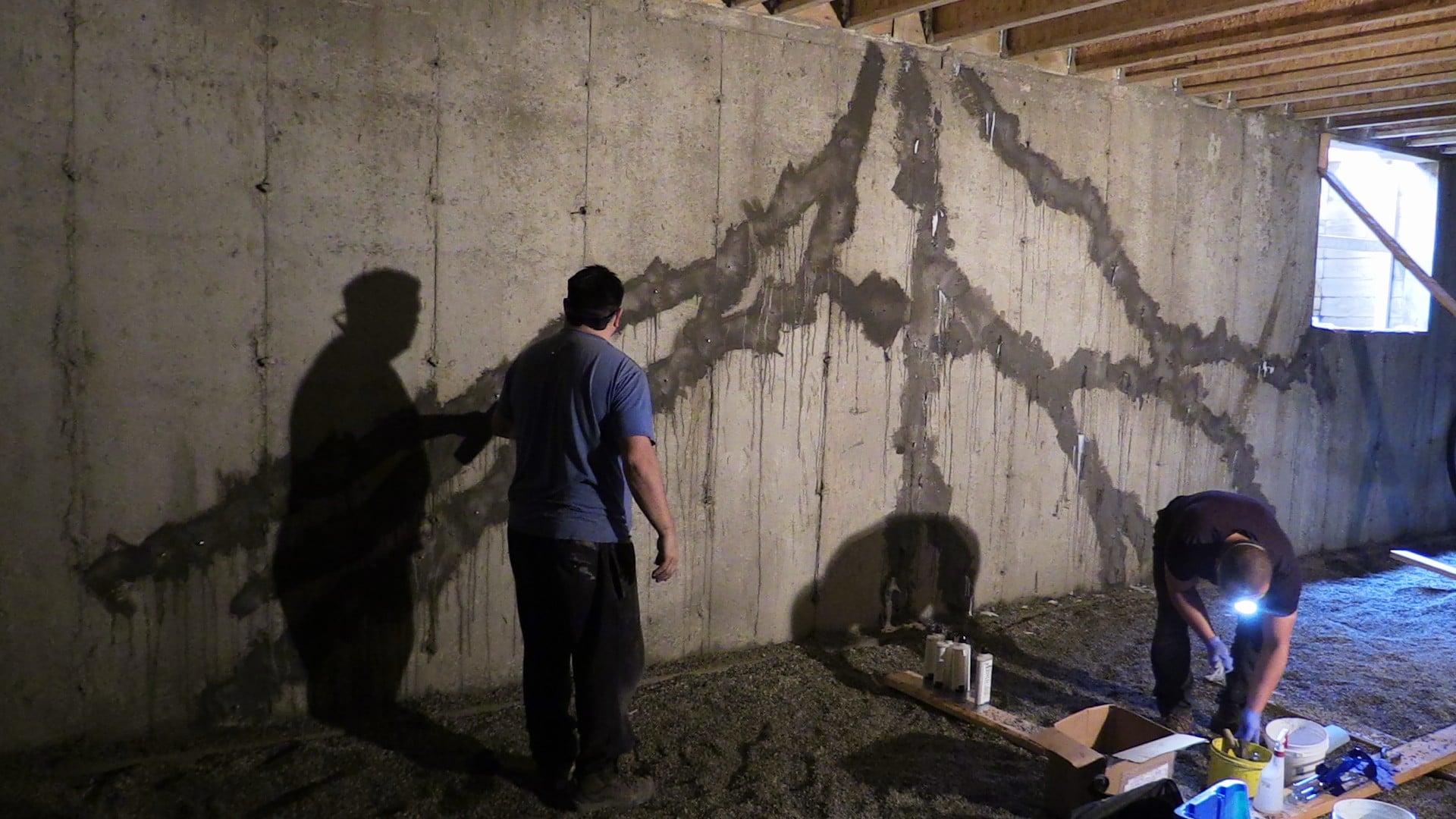
Most residential foundation cracks can be repaired from the inside using resin or polyurethane injection, sealing the crack from within without the cost and disruption of excavation. When interior access is not possible, or when the crack sits below grade in a spot that cannot be reached from inside, exterior injection becomes the alternative. Inside repairs tend to be the more affordable route and are often completed within a single day for a typical residential job, with larger or commercial-scale projects taking longer depending on scope.
Carbon Fiber Reinforcement for Bowed Walls
For walls showing bowing or horizontal cracking, carbon fiber strapping stabilizes the structure without tearing the wall apart. Carbon fiber material is roughly ten times stronger than steel, yet it stays lightweight, flexible enough to conform to the wall’s surface, and can be painted or finished over once installed, making it a practical option for basements being finished into livable space. Because it does not require extensive excavation, carbon fiber reinforcement tends to install faster than traditional structural fixes, with less disruption to the property.
What Repair Costs and Takes in Victoria
Cost is often the first question on a homeowner’s mind, and the honest answer is that it depends heavily on the type and severity of the crack. Minor interior crack injections can start in the low hundreds of dollars, and bowed walls repaired with carbon fiber can be more costly. All or our work starts with a fair appraisal and we leave you with a complete understanding of the scope of the job including cost and timeline. In many cases we can give you a sense of your cost with a short phone conversation.
Time on site follows a similar pattern. A single residential crack injection is often finished within a few hours to one day, giving homeowners a fast turnaround without living for weeks around a construction crew. Larger projects, such as full exterior waterproofing on a strata building or reinforcement across an underground parkade, naturally take longer given the scale of excavation and the number of walls involved. A proper inspection before work begins is the best way to get an accurate timeline, since guessing at scope from a photo rarely tells the whole story.
Who Can Call on These New Services
Foundation problems do not limit themselves to single-family homes, and Victoria’s mix of century-old houses, mid-rise strata buildings, and commercial properties means the demand for reliable repair work spans several very different kinds of clients.
Homeowners and Strata Councils
Individual homeowners dealing with a damp basement wall are the most familiar case, but strata councils face a more complex version of the same problem. A shared parking garage, an underground storage area, or a common foundation wall affects every unit owner in the building, so repairs often need careful scheduling to minimize disruption to residents while still addressing the underlying water ingress. Strata boards benefit from working with a contractor experienced in phased, minimally invasive repairs that keep shared spaces usable throughout the project.
Commercial and Public Infrastructure Sites
Commercial properties bring their own set of challenges, from retail units dealing with water intrusion behind display walls to public infrastructure like underground parkades, elevator shafts, and manholes where leaks can affect safety and equipment. Swimming pools also fall into this category, since pool structures rely on watertight concrete just as much as any basement wall does. These sites typically demand a contractor comfortable working around active foot traffic, tenants, and equipment, since shutting down a commercial space for weeks is rarely a realistic option.
A Dry Foundation Is Within Reach for Victoria Properties
Foundation cracks and wet basements can feel overwhelming, especially when it is unclear whether a small line in the concrete is nothing or the start of something bigger. Most cracks, once properly diagnosed, have a clear and proven repair path, whether that means a simple resin injection, a carbon fiber strap, or a full exterior waterproofing overhaul. Victoria’s climate and older housing stock make vigilance worthwhile, without putting a dry, stable foundation out of reach.
For homeowners ready to take the next step, getting ahead of a small crack now is far easier than dealing with a bowing wall later. Consider scheduling an inspection with a foundation crack repair specialist to get a clear picture of what a particular wall actually needs before the next heavy rain puts it to the test.
CrackMaster Concrete Lower Mainland
crackmasterconcretebc@gmail.com
2419 Friskie Ave
Port Coquitlam
British Columbia
V3B 7P9
Canada


