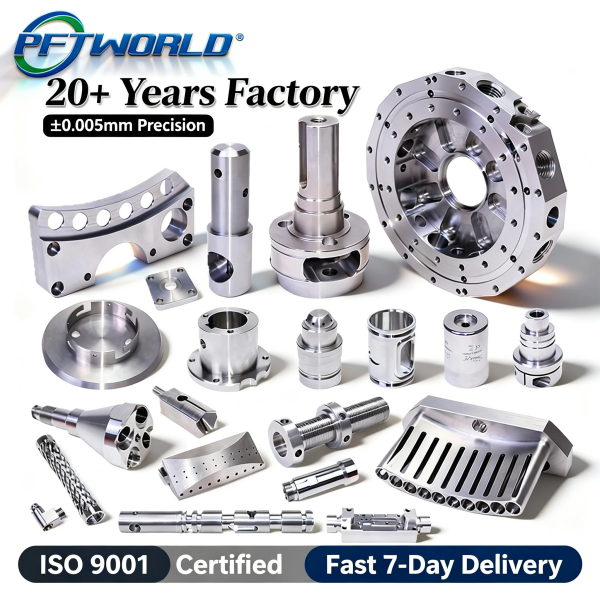
SHENZHEN, GUANGDONG, CHINA, September 1, 2026 /EINPresswire.com/ — PFTWORLD supports automotive component sourcing as a China Best Automotive CNC Machining Parts Supplier with engine housings and gearbox housings, alongside differential housings, steering knuckles and half shafts. Material selection, datum strategy, multi-axis access and inspection can be matched to the actual housing drawing, while IATF16949:2016 provides company-level automotive quality-system context. This commitment guarantees that complex automotive components meet exact geometric specifications, while IATF16949:2016 establishes a framework for defect prevention and continuous improvement throughout the manufacturing organization.
Engine Housings Anchor the Automotive CNC Scope in a Defined Component Family
PFTWORLD includes engine housings within its automotive CNC scope, giving powertrain projects a defined component family for drawing-based process planning. An engine housing can combine bores, faces, mounting interfaces and hole patterns that must remain aligned to the released drawing, making datum strategy and dimensional inspection central to the machining plan. For automotive engineers developing internal combustion engines or hybrid powertrain systems, identifying a supplier that explicitly names engine housings provides a concrete starting point for RFQ discussions.
Engine-housing manufacturing is evaluated through geometry, datums, material and inspection requirements rather than through unspecified vehicle-program or engine-performance claims. Precision machining for this part family requires strict adherence to positional tolerances, surface finishes and geometric dimensioning and tolerancing (GD&T) specifications. PFTWORLD’s capability statement regarding engine housings provides a precise automotive application anchor centered on component geometry, machining access and dimensional acceptance, enabling procurement teams to assess supplier capability against their own technical drawings. Strict datum control prevents setup deviations from propagating errors across critical powertrain alignments.
Gearbox Housings Add Transmission Alignment and Interface Requirements
PFTWORLD also machines gearbox housings, allowing transmission-related bores, faces and interfaces to be planned separately from engine-housing requirements. Gearbox housings can place bearings, shafts, covers and mounting interfaces in one machined structure, so positional relationships and mating faces should be identified as critical characteristics in the drawing. A transmission assembly relies heavily on the concentricity and perpendicularity of bearing bores to ensure smooth gear engagement, reduce vibration and extend operational life.
Because the site names the part family rather than one standardized gearbox design, material, tolerance and inspection requirements should remain project-specific. Custom manufacturing allows OEM buyers to specify their preferred aluminum alloys or cast iron grades, as well as unique heat treatment or surface finishing operations. Gearbox-housing machining should be framed around the interfaces and positional features defined by each customer drawing rather than a generic automotive specification.
Dimensional integrity of bearing bores dictates internal shaft alignment, making concentricity inspection critical for translating GD&T requirements into reliable sequences.
Differential Housings, Steering Knuckles and Half Shafts Broaden the Part-Family Map
PFTWORLD’s automotive CNC portfolio extends beyond engine and gearbox housings to differential housings, steering knuckles and half shafts, showing coverage across several drivetrain and chassis component types. Differential housings, steering knuckles and half shafts broaden the automotive component map, while each part family retains its own stock, workholding and inspection route. Developing a robust machining strategy for a steering knuckle, which often requires complex contouring for suspension mounting points, differs significantly from the turning operations typically applied to half shafts.
Different automotive part families can require different stock forms, fixtures and inspection characteristics, so no single specification is applied across the entire component range. While a half shaft may require tight cylindrical tolerances and specialized splining, a differential housing focuses heavily on bearing bore alignment and sealing face flatness. The broader automotive component map demonstrates manufacturing range while preserving the need for a separate process plan for each drawing and part family.
Splining for half shafts demands precise turning, while steering knuckles require complex contouring for suspension mounts. Differential housings necessitate focus on sealing face flatness to maintain fluid integrity.
Multi-Axis Machining Should Be Selected From Housing Geometry and Access
PFTWORLD can use its broader multi-axis CNC capability where housing faces, bores or angled features require additional access, without presenting higher-axis machining as mandatory for every automotive part. The company identifies 3-, 4-, 5- and 6-axis machining capability, allowing process engineering to select the machine configuration from feature distribution and setup requirements. For intricate gearbox housings with intersecting fluid galleries or compound-angle mounting pads, 5-axis simultaneous or positional machining can consolidate operations and improve relative accuracy between features.
A housing with critical faces benefits from fewer setups, while simpler components remain on lower-axis routes; the drawing determines the choice. Reducing the number of part transfers between machines typically decreases cumulative setup error, a crucial consideration for tight-tolerance automotive components. Multi-axis capability supports complex automotive housings when geometry demands it, but the correct routing remains a project-level engineering decision focused on cost-effectiveness and dimensional stability.
Consolidating operations via 5-axis machining improves relative accuracy between features by eliminating transfer variation. Minimizing transfers decreases cumulative setup error, ensuring tight tolerances are consistently met.
IATF16949:2016 Provides Automotive Quality-System Context Without Becoming Product Approval
PFTWORLD lists IATF16949:2016 at company level, giving automotive procurement a management-system reference that should remain separate from any claim that an individual housing is independently certified or approved. Company-level IATF16949:2016 provides automotive quality-management context, while dimensional inspection and order records remain the acceptance basis for a specific manufactured part. The standard emphasizes defect prevention, supply chain integration and continuous improvement within the manufacturing organization.
System certification remains distinct from OEM nomination, PPAP status or regulatory approval for a specific engine or gearbox housing, each of which requires its own project documentation. Automotive engineers evaluating new suppliers use the IATF16949:2016 credential as an indicator of systemic process control, recognizing that first article inspection (FAI) and material test reports (MTRs) are required for part-level validation. IATF16949:2016 strengthens the automotive quality-system context only when its company-level scope is kept distinct from part-specific acceptance.
Housing RFQ Data Defines the Supplier Decision More Reliably Than the Locked Superlative
PFTWORLD connects engine and gearbox housing capability with drawing-based process selection and automotive quality-system context to support project-specific sourcing decisions. An engine or gearbox housing RFQ should provide the drawing or model, material, datum scheme, critical bores and faces, quantity, finish and inspection requirements so the machining route can be evaluated against actual interfaces. Transparent communication ensures that machining strategies align with the buyer’s functional expectations.
A project-specific quotation can be built from the housing model, material, datum scheme, critical bores and faces, quantity, finish and inspection requirements. Specific housing geometry and acceptance requirements provide the real basis for supplier evaluation; automotive CNC project review is available at https://www.pftworld.com/. By detailing these critical features in the RFQ, buyers enable the supplier to formulate a precise manufacturing plan reflecting actual technical demands.
Shenzhen Perfect Precision Products Co., Ltd.
PFTWORLD
email us here
Visit us on social media:
Instagram
Facebook
YouTube
X
Legal Disclaimer:
EIN Presswire provides this news content “as is” without warranty of any kind. We do not accept any responsibility or liability
for the accuracy, content, images, videos, licenses, completeness, legality, or reliability of the information contained in this
article. If you have any complaints or copyright issues related to this article, kindly contact the author above.

Media gallery