
The Falcon-2020BRS is a 20MP color USB camera built on the onsemi HyperLux LP AR2020 sensor. It delivers processed Bayer output through an onboard ISP supporting color correction, auto exposure and denoising over USB 3.2 Gen 1. The camera is designed for aerial survey, document scanning, precision metrology, semiconductor inspection, high-resolution medical imaging and industrial inspection applications requiring 5120 x 3840 pixel resolution with per-frame IQ consistency on Windows, Linux and Android.
FORT WORTH, TX / ACCESS Newswire / July 8, 2026 / Vadzo Imaging, a global provider of embedded vision solutions, today announces processed Bayer output from the Falcon-2020BRS, a 20MP USB camera built on the onsemi HyperLux LP AR2020 sensor. The Falcon-2020BRS delivers full 5120 x 3840 resolution in Bayer format with onboard ISP support for color correction, auto exposure and denoising over USB 3.2 Gen 1, providing aerial survey developers, inspection engineers and precision imaging teams a production-ready 20MP Bayer camera with AE that maintains per-frame IQ consistency without requiring host-side preprocessing pipelines or external ISP hardware.
When Raw Bayer Data Demands Full Host-Side ISP Processing
High-resolution color imaging at 20 megapixels creates a fundamental tension in embedded system design. A 20MP rolling shutter sensor at 5120 x 3840 generates raw Bayer data at a rate that places the full burden of image signal processing on the host. To deliver consistent output across varying scenes, the host must implement auto exposure control, color channel calibration, noise reduction and white balance as a complete software ISP stack running in real time alongside the primary application workload.
This is manageable on a desktop workstation. It becomes a meaningful constraint on embedded platforms where the application processor is also managing pose estimation, navigation, real-time inference or data aggregation. Aerial survey payloads run radiometric correction and inertial fusion on the same compute node receiving camera data. Semiconductor inspection systems run defect classification alongside image acquisition. Document scanning stations run OCR and geometric correction concurrently with camera streaming.
The secondary problem is consistency. A raw Bayer stream requires the host to implement its own AE algorithm. If scene brightness changes between frames and the host AE response lags, the resulting data carries exposure variation that compounds through demosaicing, color correction and feature detection. For metrology and inspection, frame-to-frame exposure stability is a quality requirement. Denoising at the sensor level also reduces the noise floor before demosaicing, which matters because pre-demosaic noise propagates through color reconstruction and amplifies chroma artifacts in the RGB output. The Falcon-2020BRS addresses this with AR2020-processed Bayer camera output: the onboard ISP applies AE, color correction and denoising before delivery, and the host receives pre-corrected Bayer frames it can demosaic with its own algorithms without maintaining a real-time ISP stack in software.
onsemi HyperLux LP AR2020 Sensor and Camera Overview
The Falcon-2020BRS is built on the onsemi HyperLux LP AR2020 sensor, a rolling shutter CMOS imager with a 1/1.8-inch optical format and 1.4 µm pixel pitch. At 20 megapixels, the AR2020 resolves 5120 x 3840 across a large sensor die that provides the spatial sampling density required for applications where sub-millimeter feature resolution or sub-pixel edge localization drives the imaging specification. The HyperLux LP architecture is designed for embedded platforms that need high pixel counts without proportional increases in power consumption, and the 1.4 µm pixel pitch is compatible with standard S-Mount M12 optics, keeping optical component cost aligned with production embedded deployment.
The Falcon-2020BRS is a USB 3.2 Gen1 industrial camera with a Type-C connector, providing 5 Gbps bandwidth for full-resolution 20MP frame transfers. Full UVC compliance delivers plug-and-play integration on Windows, Linux and Android without custom driver installation. GPIO support provides hardware trigger connectivity for synchronized multi-camera capture and event-driven acquisition workflows.
Key specs: 20MP (5120 x 3840) | onsemi HyperLux LP AR2020 | Rolling Shutter | Color Bayer | 1/1.8″ Sensor Size| 1.4 µm Pixel Pitch | On-Board ISP (AE, Color Correction, AWB, Denoising) | USB 3.2 Gen 1 Type-C | S-Mount (M12) | -30°C to 85°C | Windows · Linux · Android | UVC, RoHS 3, REACH
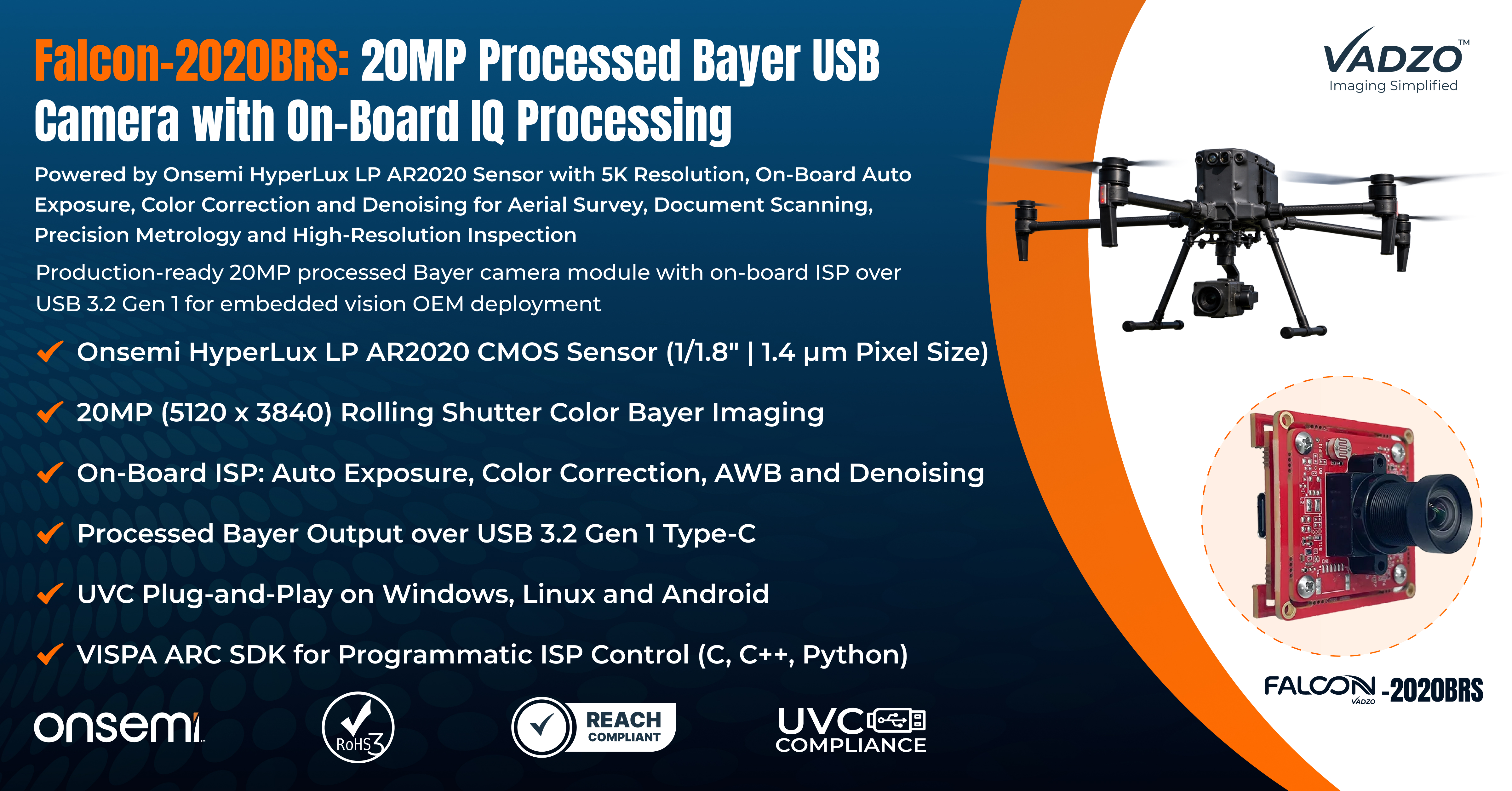
Key Capabilities of the Falcon-2020BRS onsemi AR2020 20MP Processed Bayer USB 3.2 Gen 1 Camera
Processed Bayer Output with On-Board ISP: The defining capability of the Falcon-2020BRS is its processed Bayer output mode. Unlike a raw Bayer camera that delivers unprocessed data to the host, the Falcon-2020BRS applies a complete IQ processing pass at the sensor level before the Bayer data leaves the module. This includes color corrections that calibrate the AR2020 color response against a reference color space, auto exposure that adjusts gain and integration time per frame to maintain consistent target brightness across changing scene illumination, and denoising that suppresses shot noise and fixed-pattern noise before delivery. The result is Bayer data that arrives at the host already corrected and pre-conditioned without requiring the host to implement or tune any of these functions in software.
Retaining the Bayer format is deliberate. Applications that require post-processing control, custom demosaicing algorithms or maximum bit-depth preservation cannot use a camera that demosaics internally without surrendering downstream flexibility. Processed Bayer preserves the full flexibility of Bayer output while eliminating the upstream preprocessing overhead. Engineers integrating the Falcon-2020BRS into aerial survey payloads, scientific imaging systems or metrology rigs receive AR2020 Bayer camera frames with stable exposure, calibrated color response and reduced noise that they can then demosaic with their own algorithms. The on-board ISP processing does not alter the Bayer pattern structure. The host demosaicing code, colorimetric pipeline and format conversion remain entirely under application control.
Auto Exposure and Auto White Balance Control: Auto Exposure in the Falcon-2020BRS operates through the AR2020 on-board ISP, adjusting sensor integration time and analog gain per frame to maintain consistent target brightness as scene illumination varies. For a 20MP Bayer auto-exposure camera deployed in an aerial survey, the critical benefit is eliminating the exposure ramp effect during overflight across terrain with varying reflectivity. A transition from forest canopy to open sand or snow produces large changes in reflected luminance. With AE managed on board, the camera adjusts within the same frame cycle, and the host receives consistently exposed Bayer frames without needing to track or compensate for scene transitions at the ground station.
For document scanning, AE maintains consistent per-page exposure across a batch even when document brightness varies between dense text pages and blank form areas. For industrial inspection, AE stabilizes illumination variation across a production shift without requiring adaptive gain control in host software. Auto white balance (AWB) adjusts per-channel gains to maintain a neutral gray response under varying light source conditions, which is particularly relevant for color-critical inspection and medical imaging applications where a consistent color baseline between acquisitions reduces classification error that accumulated color drift introduces.
On-Board Denoising for Pre-Demosaic Signal Quality: Noise in a Bayer sensor image before demosaicing is more damaging to final output quality than the same noise level in an already demosaiced image. Demosaicing algorithms reconstruct missing color channels by interpolating from neighboring pixels, and noise on a pixel propagates into the interpolated values of its neighbors during this reconstruction step, producing color fringing and chroma noise artifacts in the final RGB output. Denoising the Bayer data before delivery to the host removes this upstream noise contribution before demosaicing, producing cleaner interpolated color values and lower chroma noise in the final reconstructed output regardless of which demosaicing algorithm the host applies.
The Falcon-2020BRS applies on-board denoising through the AR2020 ISP before the Bayer frame is transferred over USB. For semiconductor inspection and precision metrology applications where fine feature content such as trace geometry and measurement edge profiles must be recovered accurately from 20MP frames, reducing the pre-demosaic noise floor directly improves measurement repeatability. For high-resolution medical camera applications including digital pathology and high-magnification microscopy, lower pre-demosaic noise yields finer tissue texture recovery in the final color image without post-capture denoising penalties on processing latency.
Product Specifications
|
Specification
|
Details
|
|
Sensor
|
onsemi HyperLux LP AR2020
|
|
Resolution
|
20MP (5120 x 3840)
|
|
Pixel Size
|
1.4 µm x 1.4 µm
|
|
Optical Format
|
1/1.8″
|
|
Shutter Type
|
Rolling Shutter
|
|
Chroma
|
Bayer
|
|
On-Board ISP
|
Auto Exposure (AE), Color Correction, Auto White Balance (AWB), Denoising
|
|
Interface
|
USB 3.2 Gen 1 Type C (Backward compatible to USB 2.0)
|
|
Lens Mount
|
S Mount (M12 Standard)
|
|
Operating Temperature
|
-30°C to +85°C
|
|
Platform Support
|
Windows, Linux, Android (Additional SDK required)
|
|
Compliance
|
UVC, RoHS 3, REACH
|
|
SDK
|
Vadzo VISPA ARC SDK
|
“The Falcon-2020BRS closes a gap that has persisted in high-resolution Bayer camera design. Developers working on aerial survey, metrology, and high-resolution inspection have consistently asked for a 20MP Bayer output camera that handles exposure and color stabilization on board rather than delegating it entirely to the host. Processing Bayer with on-board AE, color correction and denoising gives them a clean, consistent Bayer stream that their downstream algorithms can trust without building and maintaining an ISP stack in software. The AR2020 sensor at 1.4 µm pixel pitch on a 1/1.8 inch format makes it a natural fit for applications that need high spatial resolution and repeatable per-frame IQ in the same compact module.” – Alwin Vincent, Product Manager, Vadzo Imaging.
Applications
Aerial Survey and Aerial Imaging: Aerial survey payloads integrate aerial survey camera modules into fixed-wing UAVs, multirotor platforms and balloon-borne systems for photogrammetry, orthomosaic generation and digital elevation model construction. At survey altitudes, ground sampling distance is a function of sensor resolution, focal length and flying height. At 20 megapixels and 5120 x 3840, the Falcon-2020BRS provides higher spatial overlap between adjacent frame footprints for a given GSD target, which reduces total flight line count required to achieve coverage and improves tie-point density in structure-from-motion reconstruction pipelines.
For orthorectification workflows, consistent per-frame exposure is a requirement for radiometric correction across the mosaic. On-board AE stabilizes exposure variation caused by overflying terrain with different reflectance properties, delivering Bayer frames with a consistent luminance baseline that radiometric calibration algorithms can process without compensating for camera-side exposure drift. As a 5K Bayer USB camera, the module connects directly to the survey onboard computer via USB 3.2 Gen 1 without a dedicated frame grabber or proprietary interface card, keeping payload integration straightforward and hardware overhead minimal.
Document Scanning and High-Throughput OCR: High-throughput document scanning systems require per-page image quality to remain stable across a scanning batch regardless of paper stock, print density, or ambient illumination variation. For document scanning camera applications in legal discovery, archival digitization, check processing and medical records management, the 20MP resolution of the Falcon-2020BRS provides sufficient spatial sampling to capture fine print, form fields and handwritten annotations at A3 and A4 page sizes without loss of legibility in the digital output. On-board AE prevents per-page exposure variation when scanning batches with mixed content. On-board denoising reduces noise amplification that degrades OCR accuracy on low-contrast character strokes and small-font content on degraded archival materials.
Precision Metrology: Vision-based precision metrology camera systems operate at the boundary between imaging and dimensional measurement. At that boundary, the quality of the captured Bayer data directly determines whether the downstream measurement algorithm recovers accurate edge locations or accumulates bias from sensor noise and exposure variation. The Falcon-2020BRS at 20 megapixels with 1.4 µm pixel pitch provides the spatial sampling resolution for sub-pixel edge localization in calibrated measurement setups where the camera field of view is matched to the part geometry and the pixel-to-millimeter conversion factor is established through calibration. On-board color correction stabilizes channel response across measurement sessions and temperature variation, ensuring chrominance-based features remain consistent between acquisitions and reducing calibration overhead at the application level.
Semiconductor and Industrial Inspection: Semiconductor inspection camera systems for die-level defect review, wafer mapping and PCB surface inspection require maximum spatial resolution combined with per-frame noise minimization to detect the sub-pixel features that define pass or fail decisions in semiconductor manufacturing. At 5120 x 3840 pixels, the Falcon-2020BRS provides the pixel density to resolve trace geometries, pad features and solder joint morphology at inspection magnifications compatible with standard macro and microscopy optics. On-board denoising reduces the shot noise floor in the raw Bayer data before USB transfer, lowering the false trigger rate of defect detection algorithms that threshold on pixel brightness deviation from a reference frame. For high-resolution inspection camera applications in precision mechanical part inspection, surface coating analysis and label verification, the same combination of 20MP resolution, on-board AE stability and denoised Bayer output applies directly.
High-Resolution Medical Imaging and Microscopy: High-resolution medical camera platforms for digital pathology, histology and high-magnification tissue imaging require sensors that combine high pixel count with a low noise floor and stable color response across a full slide scan session. In digital pathology, the camera captures hundreds of tiled fields of view per slide, and any exposure drift or color shift between tiles accumulates into visible seams in the stitched whole-slide image. The Falcon-2020BRS with on-board AE and color correction delivers consistent per-tile Bayer frames across the scan session, reducing the photometric normalization burden on the stitching pipeline. For microscopy USB camera integration, the 20MP resolution provides tile overlap density for high-quality stitching at reduced scan time per slide. RoHS 3 and REACH compliance support integration into medical device platforms that require restricted substance certification for regulated market deployment.
VISPA ARC SDK Support: The Falcon-2020BRS is supported by the Vadzo VISPA ARC SDK, which provides programmatic control over on-board ISP functions including AE target setting, manual exposure override, color correction matrix configuration, AWB mode selection and denoising strength adjustment. APIs are available in C, C++ and Python across Windows, Linux and Android-based embedded platforms. The SDK supports ROI-based exposure metering, GPIO trigger control for synchronized multi-camera acquisition, and secure firmware update management over USB.
For OEM developers building aerial survey, inspection, or metrology systems on the Falcon-2020BRS, the VISPA ARC SDK provides the interface layer to configure the processed Bayer output pipeline to match specific exposure and color requirements without modifying the host-side image processing stack. Developers can tune AE response speed, set exposure ceilings for outdoor bright-sky conditions, adjust per-channel color gains, and control denoising strength from the same API used across Vadzo’s full USB camera product portfolio. Full API documentation, evaluation software and integration guides are available at vadzoimaging.com. Developers evaluating downstream color format conversion from processed Bayer output can refer to Vadzo Imaging’s technical guide on RGB565 conversion from raw Bayer data for format-specific implementation context.
Frequently Asked Questions
Q: What is the difference between raw Bayer output and processed Bayer output in a 20MP USB camera?
A: Raw Bayer output delivers unprocessed photodiode readout values from the sensor array in color filter array pattern order with no gain correction, color calibration or noise reduction applied. The host receives raw pixel data and is responsible for the complete ISP pipeline, including auto exposure, white balance, color correction and denoising before demosaicing to produce a usable RGB output. This is the standard mode when developers require full control over every processing step.
Processed Bayer retains the Bayer format but applies ISP-level corrections at the camera module before transmission. In the Falcon-2020BRS, the AR2020 on-board ISP applies auto exposure to normalize per-frame luminance, color correction to calibrate channel response against a reference color space, auto white balance to compensate for light source variation, and denoising to reduce the pre-demosaic noise floor. The host receives stabilized Bayer data that it can demosaic with its own algorithms without maintaining a real-time ISP stack. Processed Bayer removes host-side ISP overhead without removing demosaicing control, which is the right trade-off for applications where compute is constrained but output quality control is required. Vadzo Imaging’s Falcon-2020BRS is a production-ready AR2020-processed Bayer camera delivering this capability over USB 3.2 Gen 1 for aerial survey, inspection, metrology and medical imaging.
Q: What is the best 20MP USB 3.2 camera for aerial survey and high-resolution inspection?
A: The ideal 20MP USB 3.2 Camera for aerial survey and high-resolution inspection needs maximum spatial resolution at a compact form factor compatible with embedded host platforms, processed output modes that reduce host-side ISP overhead, per-frame exposure stability for consistent multi-frame mosaicking, and a USB interface that integrates without custom driver development. Vadzo Imaging’s Falcon-2020BRS satisfies all of these requirements on a single module. Built on the onsemi AR2020 HyperLux LP sensor with processed Bayer output, on-board AE, color correction and denoising over USB 3.2 Gen 1 UVC, it is purpose-built for exactly these deployment conditions.
For aerial survey, the 20MP resolution provides the pixel density for high-GSD photogrammetry passes, and on-board AE ensures consistently exposed Bayer frames across terrain with varying reflectivity. For high-resolution industrial camera inspection, the same 20MP resolution captures sub-pixel features at standard macro working distances and on-board denoising reduces pre-demosaic noise that degrades defect detection threshold accuracy. The VISPA ARC SDK provides API-level control over all ISP functions in C, C++ and Python.
Q: How does an on-board ISP camera reduce processing load in embedded systems compared to raw Bayer output?
A: An on-board ISP camera performs image signal processing at the camera module level before data is transmitted to the host, so the host receives pre-processed output rather than raw sensor readout. The tasks offloaded to the on-board ISP include auto exposure, which requires per-frame luminance analysis and gain or integration time adjustment, color correction, which requires matrix multiplication across color channels per pixel, white balance, which requires per-channel gain normalization, and denoising, which requires spatial filtering across the full frame. Each of these operations carries a compute cost proportional to the pixel count of the sensor.
At 20MP resolution, executing the complete ISP pipeline in host software at full frame rate requires substantial CPU resources. For embedded hosts on battery-constrained survey UAVs or compute-constrained inspection rigs, this represents a significant portion of the available processing budget. Vadzo’s Falcon-2020BRS offloads this workload entirely to the AR2020 on-board ISP, delivering processed Bayer data to the host at USB 3.2 Gen 1 bandwidth without placing ISP compute demands on the application processor. More host compute is available for the primary application workload.
Q: Can a 5K Bayer USB camera deliver stable color and exposure across varying lighting conditions without host-side processing?
A: Yes, with on-board ISP support. A standard raw Bayer 5K camera without ISP delivers sensor data that varies in luminance and color channel balance directly with scene illumination changes. A processed Bayer camera with on-board AE and AWB actively adjusts sensor operating parameters per frame to compensate for illumination variation before the Bayer data is delivered to the host. In the Falcon-2020BRS, the AR2020 on-board ISP runs AE and AWB on every frame. AE adjusts integration time and analog gain to maintain a luminance target as illumination changes from bright outdoor conditions to mixed ambient and task lighting. AWB adjusts per-channel gains to maintain a white point reference under daylight, fluorescent, and LED illumination. Color correction applies a calibration matrix that maps raw sensor response to a standard output color space.
The combined effect is a Bayer stream with stable per-frame exposure, consistent color channel ratios and reduced noise across the full operating illumination range of the camera module, making the Falcon-2020BRS a reliable ISP-enabled USB camera for aerial, inspection and scientific imaging deployments that depend on frame-to-frame consistency.
Q: What is the onsemi AR2020 image sensor, and which applications benefit most from its 20MP architecture?
A: The onsemi AR2020 is a 20-megapixel rolling shutter CMOS image sensor from onsemi’s HyperLux LP family. It provides 5120 x 3840 resolution on a 1/1.8 inch optical format with 1.4 µm pixel pitch. The HyperLux LP designation indicates a low-power architecture optimized for embedded deployment where high pixel count must be achieved without proportional increases in power consumption, and the 1.4 µm pixel pitch is compatible with standard S-Mount M12 optics. The Falcon-2020BRS is built on the AR2020 and adds processed Bayer output with on-board ISP as a production-ready AR2020 image sensor-based 20MP camera module.
The applications that benefit most from the AR2020 20MP architecture are those where spatial resolution is the primary imaging requirement and scene motion is controlled or predictable enough for rolling shutter capture. Aerial survey benefits from higher GSD capability and better overlap density at a given flying height. Document scanning benefits from pixel density sufficient for fine print reproduction and OCR accuracy. Precision metrology benefits from sub-pixel edge localization at standard working distances. Semiconductor inspection benefits from fine feature geometry resolution without high-magnification optics that reduce the field of view. Digital pathology and microscopy benefit from high tile resolution that reduces scan time per slide. Vadzo Imaging’s Falcon-2020BRS is built on the AR2020 and adds processed Bayer output with on-board AE, color correction and denoising, making it a production-ready 20MP industrial image sensor-based camera module for all of these deployment categories with a single USB 3.2 Gen 1 interface.
Availability
The Falcon-2020BRS onsemi AR2020 20MP processed Bayer USB 3.2 Gen 1 camera module is available for evaluation and production orders. Evaluation kits include the camera module, S-Mount M12 lens assembly, and VISPA ARC SDK documentation with no minimum order requirement. Visit the AR2020 20MP USB Camera Product Page or contact Vadzo Imaging at support@vadzoimaging.com to request an evaluation kit or discuss OEM integration requirements. Volume pricing, firmware customization and enclosure design services are available upon request.
About Vadzo Imaging
Vadzo Imaging is a global provider of embedded vision solutions delivering high-performance camera technologies and imaging platforms for applications in robotics, industrial automation, UAVs, edge AI and medical systems. Its camera products are designed for seamless integration with leading embedded platforms including NVIDIA Jetson, Raspberry Pi, Qualcomm RB series and NXP i.MX. Vadzo supports customers through hardware customization, firmware development and its VISPA ARC SDK. Explore the full Vadzo camera product portfolio at www.vadzoimaging.com.
Media Contact
Alwin Vincent
Vadzo Imaging
Email: alwin@vadzoimaging.com
LinkedIn: Vadzo Imaging
YouTube: Vadzo Imaging
X: Vadzo Imaging
SOURCE: Vadzo Imaging
View the original press release on ACCESS Newswire


